
Advantages, Limitations & Industrial Application Value of RDE-AES Oil Analysis
As a mainstream rapid detection technology in the field of industrial oil monitoring, RDE-AES has unique technical advantages that traditional detection methods cannot match. Meanwhile, it has clear applicable scenarios and technical limitations. Reasonable understanding of its performance characteristics and industrial value can help enterprises give full play to the role of oil spectrum analysis in predictive maintenance and realize scientific oil management and equipment fault early warning.
Core Technical Advantages of RDE-AES
1. Ultra-low Sample Pretreatment Cost
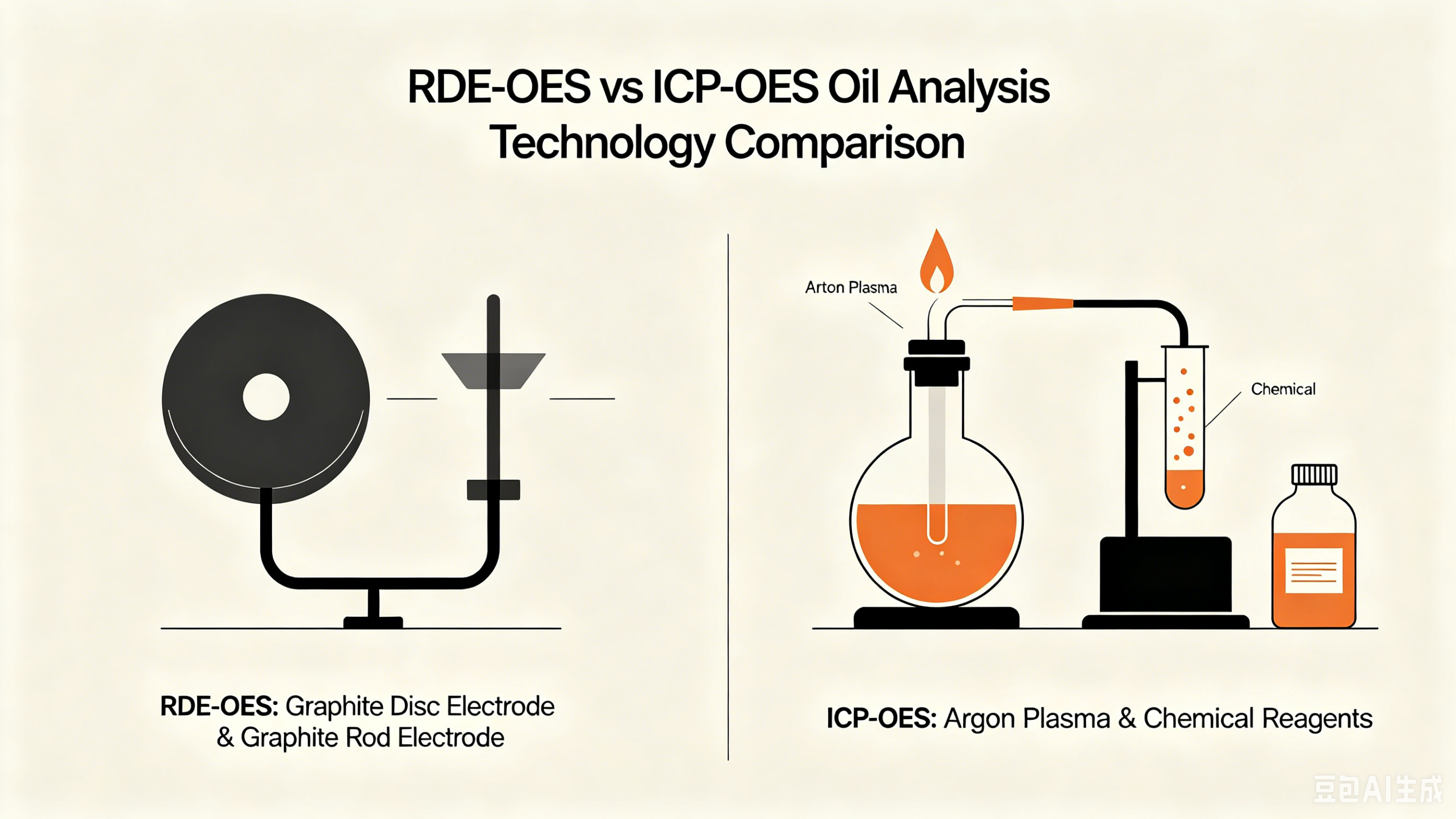
Different from ICP and other precision analytical technologies that require complex acid digestion, heating, dilution and impurity removal processes, RDE-AES supports direct testing of original oil samples. It completely eliminates manual pretreatment steps, avoids element loss and secondary pollution caused by human operation, greatly improves detection efficiency, and reduces laboratory operation costs.
2. Efficient Multi-element Synchronous Detection
A single RDE-AES test only takes 1–2 minutes, and it can synchronously detect more than 20 key elements in oil samples. Compared with single-index detection methods, it realizes one-time comprehensive detection of wear metals, pollutants and additives, which is very suitable for batch sample testing in industrial sites and professional laboratories.
3. High Sensitivity for Trace Detection
The instrument has extremely high detection sensitivity, with the detection limit of most metal elements reaching 0.1–1 mg/kg. It can accurately capture trace wear and micro-pollution signals in the early stage of equipment failure, realize early fault warning before obvious equipment abnormality occurs, and avoid major shutdown losses caused by delayed fault discovery.
4. Dual Adaptability for Laboratory and On-Site Use
RDE-AES oil spectrum analyzer has strong environmental adaptability and stable performance. It can meet the requirements of high-precision quantitative detection in professional laboratories and rapid screening diagnosis on industrial production sites. It is widely applicable to condition monitoring of engine oil, hydraulic oil, gear oil and various other industrial lubricating oils.
Technical Limitations and Matching Solutions
Although RDE-AES has outstanding comprehensive performance, it has certain technical limitations in practical application, which need to be compensated by matching detection means to realize full-condition oil monitoring:
First, for large metal particles with a particle size greater than 10 μm, the high-temperature arc excitation is insufficient, resulting in slightly lower test results. For large particle wear monitoring, it needs to be used in combination with ferrography analysis and particle counting technology to form a comprehensive wear evaluation system.
Second, RDE-AES can only detect the total content of target elements in oil samples, and cannot distinguish dissolved metal elements and suspended particulate metals. In-depth analysis of wear forms requires auxiliary technical means for verification.
Third, excessive free moisture in oil samples will interfere with the stability of high-voltage arc discharge and affect test accuracy. For oil samples with high water content, simple dehydration pretreatment is required before testing.
Industrial Application Value of RDE-AES Technology
RDE-AES oil spectrum analysis is a core technical support for industrial equipment predictive maintenance and intelligent oil management. By long-term monitoring of element changes in used lubricating and hydraulic oils, enterprises can accurately judge the wear state of mechanical friction parts, timely identify external system pollution and coolant leakage faults, and scientifically evaluate the aging degree and failure cycle of oil products.
In actual industrial operation, this technology helps enterprises formulate scientific oil replacement cycles, avoid excessive oil replacement caused by empirical management, and reduce operating costs. More importantly, it can early warn of potential mechanical faults, effectively avoid unplanned equipment shutdowns caused by abnormal wear and system pollution, and significantly improve the operating stability, safety and service life of industrial equipment.
Conclusion
RDE-AES has become a mainstream and reliable technology in the field of used oil analysis by virtue of its fast detection speed, simple operation, high sensitivity and low comprehensive cost. Despite partial technical limitations, it can fully meet the conventional and daily monitoring needs of industrial oil products with reasonable auxiliary detection matching.
Long-term application of RDE-AES oil spectrum analysis can help enterprises realize refined management of lubricating media and intelligent early warning of equipment faults, providing solid data support for the efficient and stable operation of modern industrial systems.
Keywords: RDE-AES advantages, oil analysis limitations, industrial predictive maintenance, used hydraulic oil monitoring

Leave a Reply